



EPOCHAL ACADEMIC INVESTITURE | EXCLUSIVE FEATURE
Architect of Tomorrow’s Intelligence: Dr. Nutan Naidu’s Quadruple Doctorate & Full Professorship Redefine the Boundaries of Global Scholarship
Dr. Nutan Naidu, How One Polymath’s Unprecedented Cross-Disciplinary Ascendancy Is Recalibrating the Intellectual Architecture of Artificial Intelligence, Digital Jurisprudence, and Neurocognitive Governance
NEW DELHI, INDIA — In an era characterized by the precipitous acceleration of technological disruption and the labyrinthine complexities of digital governance, the global academic firmament has borne witness to a distinction of extraordinary rarity.

Frankford International University — an institution of formidable scholarly repute and consecrated intellectual rigour — has formally conferred upon Dr. Nutan Naidu a Doctorate in AI Ethics alongside a Full Professorship in Digital Law: a simultaneous dual investiture that the institution itself acknowledges as constituting a first-of-its-kind precedent within this exquisitely rarified cross-disciplinary domain.

The magnitude of this felicitation, solemnized at the Holiday Inn, Mayur Vihar, New Delhi, transcends ceremonial pageantry. It represents the institutional crystallization of a decades-long intellectual odyssey — one that has positioned Dr. Naidu as arguably the most cognitively pluridisciplinary academic operative currently active within India’s knowledge economy.
The Quadruple Doctorate Phenomenon: Unprecedented Credentialist Architecture
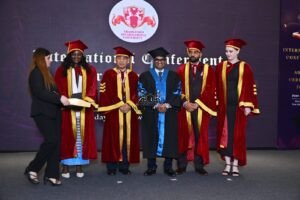
What distinguishes this latest conferment from its antecedents is not merely its subject matter, but its cumulative positioning within an already staggering portfolio of doctoral attainment. This Doctorate in AI Ethics constitutes Dr. Naidu’s fourth concurrent doctoral credential — a pedagogical feat that strains the conventional imagination of academic credentialism.

His extant doctoral constellation encompasses: a Doctorate in Human Resource Management, a Doctorate in Higher Education Systems Management, and an advanced Doctor of Arts in Astrology — disciplines whose epistemological divergence speaks less to intellectual restlessness and more to a deliberate, architectured polymathy engineered for cross-domain application.
A UGC National Eligibility Test (NET) qualified professor and a visiting academic presence across 17 international universities spanning geographically heterogeneous jurisdictions, Dr. Naidu has institutionalized his intellectual currency across a remarkable transnational pedagogical footprint. He is, by both credential and praxis, a trainer of trainers — an academic multiplier whose intellectual leverage compounds exponentially through the networks he cultivates.
The Techno-Legal Synthesis: Where Cyber Jurisprudence Meets Responsible AI Engineering
Central to Dr. Naidu’s emergent scholarly identity is an architectural fusion that very few practitioners worldwide have managed to operationalize with comparable coherence: the convergence of digital forensics, cyber law, and responsible artificial intelligence engineering.
Over the antecedent three-to-four years, Dr. Naidu has prosecuted an aggressive campaign of technical augmentation — securing elite-tier advanced certifications in Cyber Law, Digital Forensics, and Information Technology from such apex institutions as IIT Kanpur and NALSAR University of Law. These are not ornamental credentials appended to an already distinguished curriculum vitae; they represent the forensic and jurisprudential substratum upon which his AI ethics framework is architecturally load-bearing.
The resultant intellectual amalgam — part technologist, part legal theorist, part behavioral scientist — positions Dr. Naidu at the precise epistemological intersection where algorithmic accountability, data sovereignty, and institutional compliance converge into actionable governance frameworks.
Neurocognitive Political Engineering: The Vanguard Application of His Multidimensional Expertise
Perhaps the most arresting dimension of Dr. Naidu’s applied scholarship lies in a domain that conventional academia has historically resisted colonizing with rigorous scientific methodology: electoral science and digital political consulting.
Synthesizing cognitive neuroscience with predictive AI data analytics, Dr. Naidu has constructed what may be described as a mathematical phenomenology of democratic persuasion — architecting sophisticated voter sentiment models, algorithmically micro-targeted digital campaign architectures, and real-time political risk mitigation protocols capable of navigating the hypercomplex narrative ecosystems of contemporary electoral contestation.
This is not political commentary masquerading as scholarship. It is the systematic application of behavioral science, neural patterning theory, and probabilistic algorithmic modeling to the quintessentially human theater of democratic representation — a field in which Dr. Naidu has established consultancy precedents of demonstrable consequence both domestically within India and across international political landscapes.
Twenty-Five Years of Executive Capital: The Corporate Crucible That Forged the Academician
Undergirding this extraordinary scholarly superstructure is a quarter-century of executive-level corporate immersion — a professional lineage encompassing high-stakes management consulting, cloud-native data architecture, and cognitive enterprise design across small, medium, and large-scale multinational organizational ecosystems.
This corporate crucible has ensured that Dr. Naidu’s academic contributions are never purely theoretical constructs detached from operational reality. His research carries the epistemological authority of lived organizational complexity — a quality that renders his scholarship simultaneously intellectually rigorous and institutionally actionable.
His capacity to orchestrate cross-functional human capital transformation initiatives alongside digital governance redesign programs across diverse multinational contexts has cultivated an executive intelligence that most purely academic practitioners simply cannot replicate.
Why This Story Matters: The Structural Significance for India’s Knowledge Economy
India currently occupies a geopolitically consequential inflection point in the global AI governance discourse. As nations worldwide scramble to erect coherent regulatory architectures around artificial intelligence — navigating the tension between technological permissiveness and ethical constraint — the country requires scholars who can operate simultaneously in the registers of technical fluency, legal enforceability, and ethical philosophy.
Dr. Nutan Naidu’s investiture is not simply a biographical milestone. It is a structural signal: that India’s academic ecosystem is beginning to produce and recognize the polymath-specialists that the next phase of civilizational AI governance will demand.
In an intellectual landscape dominated by disciplinary silos, he represents the integrationist alternative — a scholar whose very credentialist architecture embodies the cross-domain synthesis that the challenges of our technological epoch necessitate.
This feature has been produced as an independent academic profile and does not constitute editorial endorsement of any affiliated institution, political consultancy, or certification body referenced herein.



Hi, this is a comment.
To get started with moderating, editing, and deleting comments, please visit the Comments screen in the dashboard.
Commenter avatars come from Gravatar.